Business Insurance for Accountants and Mortgage Brokers in Phoenix & Tucson
In the dynamic business environments of Phoenix, Tucson, and their surrounding Arizona communities, accountants, CPAs, and mortgage brokers face a unique set of risks and regulatory requirements. Whether you operate a boutique CPA firm in Scottsdale, a bustling mortgage brokerage in Chandler, or a tax consultancy in downtown Tucson, your professional reputation and financial stability hinge on robust risk management. Business insurance, surety bonds, and professional liability insurance are not just regulatory checkboxes—they are essential tools for protecting your practice, meeting client and lender demands, and building long-term trust.
Smart Options Insurance Agency, LLC, based in Peoria and serving the entire Arizona region, specializes in helping professionals like you navigate the complexities of insurance and bonding. This comprehensive guide explores the local market landscape, regulatory requirements, insurance product comparisons, compliance essentials, and actionable strategies for accountants, CPAs, and mortgage brokers in the Phoenix and Tucson metros. We’ll also answer your most pressing questions and provide practical tips for risk management and marketing your professional services.
---
The Local Market: Accountants, CPAs, and Mortgage Brokers in Phoenix & Tucson
Accounting and CPA Landscape
The Phoenix and Tucson metropolitan areas are home to a thriving community of accounting professionals, ranging from solo practitioners to regional and national firms. In 2025, the Phoenix area alone boasted nearly 4,400 professional staff across its 97 largest accounting firms, with major players like Deloitte, EY, PwC, and KPMG maintaining significant local presences. Alongside these giants, Arizona’s business ecosystem supports hundreds of small and mid-sized CPA firms, tax preparers, bookkeepers, and consultants, many of whom serve the state’s diverse industries—from real estate and healthcare to technology and construction.
Key Market Insights:
- The top 10 accounting firms in Arizona (30+ CPAs) include Wallace Plese + Dreher, Baker Tilly, Moss Adams, and CBIZ, among others.
- Smaller firms (5–29 CPAs) and boutique practices (4 or fewer CPAs) are highly regarded for personalized service and deep client relationships.
- The demand for specialized accounting services—such as tax planning, audit, mergers and acquisitions, and consulting—remains strong, especially as Arizona’s economy continues to expand.
Mortgage Broker and Lending Sector
Arizona’s mortgage industry is a cornerstone of the state’s real estate and financial sectors. With a growing population and robust housing market, mortgage brokers and bankers play a pivotal role in facilitating homeownership and investment. Both Phoenix and Tucson are hubs for mortgage activity, with numerous independent brokers, branch offices of national lenders, and hybrid real estate-finance firms.
Key Market Insights:
- Mortgage brokers must be licensed and bonded to operate in Arizona, with specific requirements for experience, education, and financial responsibility.
- The industry is regulated by the Arizona Department of Insurance and Financial Institutions (DIFI), which enforces strict compliance and consumer protection standards.
- Mortgage professionals face heightened scrutiny from both regulators and clients, making risk management and insurance coverage critical for business continuity.
---
Regulatory and Licensing Requirements in Arizona
Accountants and CPAs
While Arizona does not mandate professional liability insurance for CPAs or accountants by law, many clients—especially larger businesses, government entities, and financial institutions—require proof of coverage as a condition of engagement. Additionally, accounting firms with employees must carry workers’ compensation insurance, and those with physical offices should consider property and general liability coverage.
Best Practices:
- Maintain up-to-date professional liability (E&O) insurance to protect against claims of negligence, errors, or omissions.
- Use engagement letters for every client relationship to clarify scope, responsibilities, and risk allocation.
- Stay current with AICPA and Arizona Board of Accountancy standards for ethics, continuing education, and practice management.
Mortgage Brokers
Arizona mortgage brokers are subject to some of the most rigorous licensing and bonding requirements in the country. To obtain and maintain a mortgage broker license, applicants must:
- Demonstrate at least three years of relevant experience within the past five years.
- Complete an approved course of study and pass a state-administered exam.
- Submit to a criminal background check and provide financial statements.
- Obtain a surety bond—$10,000 for brokers working solely with institutional investors, or $15,000 if any non-institutional investors are involved.
- File all documentation through the Nationwide Multistate Licensing System & Registry (NMLS).
Compliance Tip:
Failure to maintain an active surety bond can result in license suspension or revocation, civil penalties, and legal liability for client losses.
---
Insurance and Bonding Needs for Accounting and Mortgage Firms
Business Insurance Essentials
For Accountants, CPAs, and Mortgage Brokers:
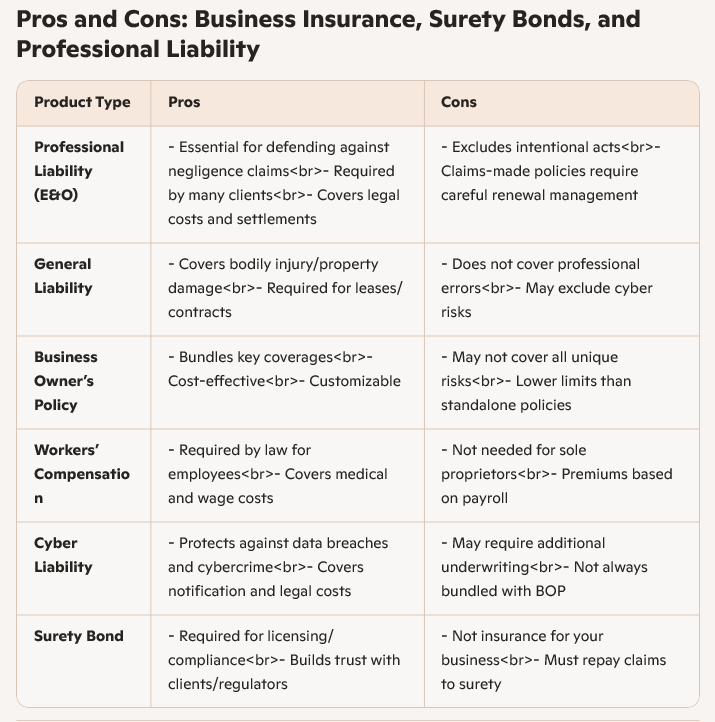
- General Liability Insurance: Protects against third-party bodily injury, property damage, and advertising injury claims. Essential for any office-based business or client-facing practice.
- Property Insurance: Covers office equipment, furniture, and physical assets against fire, theft, vandalism, and certain natural disasters.
- Workers’ Compensation: Required by Arizona law for any business with employees; covers medical expenses and lost wages for work-related injuries or illnesses.
- Cyber Liability: Increasingly important for firms handling sensitive financial data, protecting against data breaches, ransomware, and cyber extortion.
- Business Owner’s Policy (BOP): Bundles general liability and property insurance at a cost-effective rate, often with additional endorsements for business interruption and equipment breakdown.
Professional Liability Insurance (Errors & Omissions, E&O)
Why It Matters:
Professional liability insurance is the cornerstone of risk management for accountants, CPAs, and mortgage brokers. It covers legal defense costs, settlements, and judgments arising from claims of negligence, errors, omissions, or failure to deliver professional services as promised.
Typical Coverage Scenarios:
- A CPA makes a tax filing error resulting in IRS penalties for a client.
- A mortgage broker is accused of providing inaccurate loan advice, leading to financial loss for a borrower.
- An accountant is sued for failing to detect fraud or for breach of fiduciary duty.
Key Features:
- Defense costs, even if allegations are groundless.
- Coverage for disciplinary proceedings and regulatory investigations.
- Optional endorsements for additional services (e.g., investment advice, notary services, fiduciary roles).
- Choice of claims-made or occurrence policy forms (see below for comparison).
Cost Factors:
- Firm size, gross revenue, and number of professionals.
- Claims history and risk profile.
- Types of services offered (audit, tax, consulting, etc.).
- Use of engagement letters and risk management protocols.
Surety Bonds
What Is a Surety Bond?
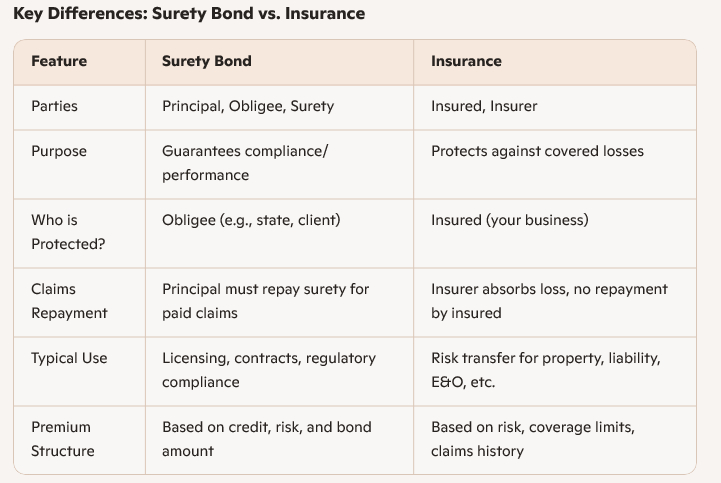
A surety bond is a three-party agreement among the principal (the business or professional), the obligee (the party requiring the bond, often a regulatory agency), and the surety (the bonding company). It guarantees that the principal will comply with laws, regulations, or contractual obligations. If the principal fails, the surety pays the obligee and seeks reimbursement from the principal.
Arizona Mortgage Broker Bond Requirements:
- $10,000 bond for brokers with only institutional investors.
- $15,000 bond for brokers with any non-institutional investors.
- Premiums typically range from 1% to 10% of the bond amount, depending on credit score and financial history.
- Required for initial licensing and must be maintained continuously.
Other Common Bonds:
- License & permit bonds for other regulated professions.
- Bid, performance, and payment bonds for contractors.
- Lost instrument bonds for financial transactions.
Analysis:
While both surety bonds and insurance are essential for compliance and risk management, they serve distinct purposes. Surety bonds protect the public and regulators, ensuring you fulfill your obligations, while insurance protects your business from financial loss due to lawsuits, accidents, or errors.
---
Comparing Insurance Products: Pros and Cons
Detailed Analysis:
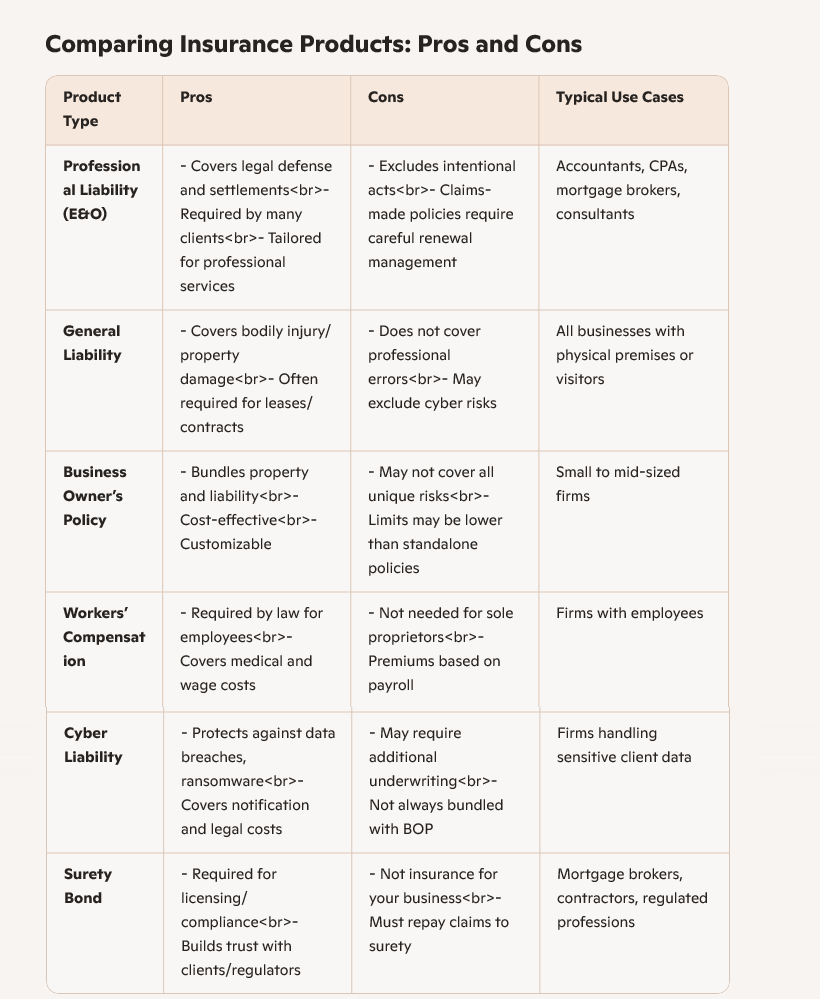
Professional liability insurance is indispensable for accountants and mortgage brokers, as even a single claim can result in six-figure legal costs or settlements. General liability is foundational for any business with a physical office or client interactions. A BOP is a cost-effective way to bundle key coverages, but may not be sufficient for firms with complex risks. Cyber liability is increasingly important as financial professionals become targets for cybercrime. Surety bonds are a legal requirement for mortgage brokers and a mark of credibility for other licensed professionals.
---
Compliance and Contract Requirements: Certificates of Insurance (COIs)
What Is a COI?
A Certificate of Insurance (COI) is an official document issued by your insurer that verifies your coverage, policy limits, and effective dates. COIs are often required by clients, lenders, landlords, and regulatory agencies as proof of insurance or bonding.
Why Are COIs Important?
- Contractual Compliance: Many business contracts, especially with lenders or institutional clients, require you to provide a COI before work begins.
- Risk Transfer: COIs ensure that all parties are protected in case of loss, injury, or professional error.
- Regulatory Requirements: Mortgage brokers must provide proof of surety bond and insurance to maintain licensure.
Best Practices:
- Request and provide updated COIs at the start of every engagement or contract renewal.
- Ensure that COIs list all required coverages and endorsements (e.g., additional insured, waiver of subrogation).
- Use contract management software or a COI tracking system to automate compliance and renewal reminders.
- Regularly audit your COIs to ensure ongoing compliance and avoid lapses in coverage.
Consequences of Non-Compliance:
- Contract termination or payment delays.
- Regulatory fines or license suspension.
- Exposure to uninsured claims and legal liability.
---
Claims Examples and Risk Scenarios
For Accountants and CPAs
Common Claims:
- Negligent Errors or Omissions: Failing to file a client’s tax return on time, resulting in penalties.
- Failure to Detect Fraud: Missing signs of embezzlement during an audit, leading to client losses.
- Incorrect Tax Advice: Advising a client on a tax strategy that is later disallowed by the IRS, causing financial harm.
- Breach of Fiduciary Duty: Mishandling client funds or failing to act in the client’s best interest.
- Conflict of Interest: Providing services to competing clients without proper disclosure.
Impact:
Accounting malpractice claims can result in substantial financial damages, reputational harm, and regulatory investigations. Professional liability insurance covers legal defense, settlements, and certain regulatory proceedings, but may exclude intentional acts or fraud.
For Mortgage Brokers
Common Claims:
- Misrepresentation: Providing inaccurate information about loan terms or eligibility.
- Failure to Disclose Fees: Not fully disclosing all costs associated with a mortgage, leading to client complaints.
- Regulatory Violations: Failing to comply with state or federal lending laws, resulting in fines or license suspension.
- Breach of Contract: Not delivering services as promised in the broker agreement.
Surety Bond Claims:
If a mortgage broker violates licensing laws or commits fraud, clients or regulators can file a claim against the surety bond. The surety pays valid claims and seeks reimbursement from the broker, which can jeopardize future licensing and bonding ability.
---
Cost and Pricing: What to Expect in Arizona
Professional Liability Insurance
- Average Cost for Accountants/CPAs:
- Small firms: $60–$80/month ($720–$960/year) for $1M/$2M limits.
- Larger firms or those with higher risk profiles may pay more.
- Premiums are influenced by revenue, services offered, claims history, and use of engagement letters.
- Average Cost for Mortgage Brokers:
- Professional liability (E&O): $140–$193/month ($1,680–$2,316/year) for $1M/$2M limits.
- General liability: $20–$27/month.
- Workers’ comp: $12–$16/month per employee.
- BOP: $29–$39/month.
Surety Bonds
- Mortgage Broker Bond:
- $10,000 bond: $100–$300/year (good credit), up to $1,000/year (poor credit).
- $15,000 bond: $150–$450/year (good credit), up to $1,500/year (poor credit).
- Premiums are based on credit score, financial history, and business experience.
- Other Bonds:
- License & permit bonds: Vary by profession and regulatory requirements.
- Commercial bonds: Rates depend on bond type and risk profile.
Factors Affecting Pricing
- Credit score and financial stability.
- Claims history and prior bond claims.
- Type and volume of services provided.
- Use of risk management practices (e.g., engagement letters, internal controls).
- Location (urban vs. rural, Phoenix/Tucson vs. outlying areas).
---
Smart Options Insurance Agency, LLC: Local Expertise and Tailored Solutions
About Smart Options:
With over 20 years of experience, Smart Options Insurance Agency, LLC, headquartered in Peoria, AZ, is a trusted partner for accountants, CPAs, mortgage brokers, and other professionals throughout Phoenix, Tucson, and the surrounding cities. As an independent agency, Smart Options offers unbiased advice, access to top-rated carriers, and personalized service for both business and personal insurance needs.
Why Choose Smart Options?
- Deep knowledge of Arizona’s regulatory landscape and local business environment.
- Tailored insurance and bonding solutions for accounting and mortgage professionals.
- Fast, responsive service and 24/7 client support.
- Interactive tools and educational resources to help you understand your coverage.
- Commitment to transparency, compliance, and client advocacy.
Key Offerings:
- Business insurance (general liability, property, BOP, workers’ comp, cyber, EPLI).
- Professional liability (E&O) for accountants, CPAs, and mortgage brokers.
- Surety and commercial bonds for licensing and contract compliance.
- Certificates of insurance and compliance support.
- Risk management guidance and annual policy reviews.
---
Policy Features and Endorsements for Accounting and Mortgage Practices
For Accountants and CPAs
- Defense Costs Outside Limits: Ensures legal fees do not erode your policy limits.
- Disciplinary Proceedings Coverage: Pays for legal defense in regulatory investigations.
- Coverage for Additional Services: Endorsements for investment advice, fiduciary roles, notary services, and more.
- Prior Acts Coverage: Protects against claims arising from past services, provided there is no gap in coverage.
- Engagement Letter Credits: Some insurers offer premium discounts for consistent use of engagement letters.
- Claims-Made vs. Occurrence Forms: Most professional liability policies are claims-made, requiring continuous coverage and careful management of retroactive dates and tail coverage options.
For Mortgage Brokers
- Surety Bond Compliance: Meets Arizona’s licensing requirements and protects clients from misconduct.
- E&O Endorsements: Coverage for regulatory violations, misrepresentation, and contract disputes.
- Cyber Liability: Protection against data breaches and client information theft.
- General Liability and Property: Covers office risks, client injuries, and property damage.
- Workers’ Compensation: Required for firms with employees.
---
Risk Management and Loss Prevention Best Practices
For Accountants, CPAs, and Mortgage Brokers:
1. Use Engagement Letters:
- Clearly define the scope of services, responsibilities, fees, and dispute resolution procedures.
- Update letters annually and whenever the engagement changes.
- Engagement letters are a critical defense in malpractice claims and can reduce claim severity.
2. Maintain Internal Controls:
- Implement checks and balances for financial transactions, client communications, and document retention.
- Regularly review and update compliance protocols.
3. Stay Current with Continuing Education:
- Keep up with changes in tax law, lending regulations, and professional standards.
- Participate in industry associations and local networking groups.
4. Monitor COI Compliance:
- Track all certificates of insurance and bond renewals.
- Use technology to automate reminders and document management.
5. Respond Promptly to Claims or Complaints:
- Notify your insurer immediately if you receive a claim, subpoena, or regulatory inquiry.
- Cooperate fully with investigations and maintain detailed records.
6. Educate Your Team:
- Train staff on compliance, ethics, and client communication.
- Foster a culture of transparency and accountability.
7. Review Coverage Annually:
- Work with your insurance advisor to assess changing risks, business growth, and new service offerings.
---
Frequently Asked Questions (FAQ)
1. What types of insurance are essential for accountants, CPAs, and mortgage brokers in Arizona?
Answer:
At a minimum, you should carry professional liability (E&O) insurance, general liability, and property insurance. Mortgage brokers must also maintain a surety bond as required by state law. If you have employees, workers’ compensation is mandatory. Cyber liability and employment practices liability insurance (EPLI) are recommended for added protection.
2. What is the difference between a surety bond and insurance?
Answer:
A surety bond is a three-party agreement guaranteeing your compliance with laws or contracts; if you default, the surety pays the obligee and seeks reimbursement from you. Insurance is a two-party contract that protects your business from covered losses, with the insurer absorbing the risk and not seeking repayment from you.
3. How much does professional liability insurance cost in Arizona?
Answer:
For accountants and CPAs, premiums typically range from $60–$80/month for small firms, with higher rates for larger practices or those with claims history. Mortgage brokers can expect to pay $140–$193/month for E&O coverage. Premiums depend on firm size, revenue, services, and risk profile.
4. What are the surety bond requirements for Arizona mortgage brokers?
Answer:
Mortgage brokers must obtain a $10,000 bond if working only with institutional investors, or a $15,000 bond if any non-institutional investors are involved. Premiums range from 1% to 10% of the bond amount, based on credit and financial history. The bond must be maintained continuously to keep your license active.
5. What is a Certificate of Insurance (COI), and why do I need one?
Answer:
A COI is an official document proving your insurance coverage. Clients, lenders, and regulators often require a COI before engaging your services or releasing payments. It demonstrates compliance and risk transfer, protecting all parties in case of a claim.
6. What is the difference between a claims-made and occurrence policy?
Answer:
A claims-made policy covers claims made during the policy period, regardless of when the incident occurred (as long as it’s after the retroactive date). An occurrence policy covers incidents that happen during the policy period, even if the claim is filed later. Most professional liability policies are claims-made, requiring careful management of renewals and tail coverage options.
7. How can I reduce my insurance premiums?
Answer:
Maintain a clean claims history, use engagement letters consistently, implement strong internal controls, and work with an experienced insurance advisor to shop for competitive rates. Some insurers offer discounts for risk management practices and multi-policy bundles.
8. What should I do if I receive a claim or regulatory inquiry?
Answer:
Notify your insurer immediately, provide all requested documentation, and avoid admitting fault or making settlements without insurer approval. Prompt reporting is essential to preserve your coverage and defense rights.
9. Can I get insurance or a bond with poor credit or a prior claim?
Answer:
Yes, but premiums may be higher, and underwriting may require additional documentation or collateral. Specialized programs exist for high-risk applicants, but maintaining good credit and compliance is the best way to secure affordable coverage.
10. How often should I review my insurance and bonding needs?
Answer:
At least annually, or whenever your business grows, adds new services, hires employees, or faces new regulatory requirements. An annual review with your insurance advisor ensures your coverage keeps pace with your evolving risks.
Pros and Cons: Business Insurance, Surety Bonds, and Professional Liability